This article is part of my university’s project “Saxony-Anhalt in Numbers“. During the seminar, we analysed different aspects of the regional elections in September 2026 using Open Data Sources. For the story, I sought out an experts’ opinion, organised a protagonist, conducted interviews with different people of higher ages and used Excel and Datawrapper to visualise the Data. The original published article in German can be accessed here.
26/07/2026
A Data Story
In every election, the main focus is on who wins and who loses. But who has the greatest influence on this decision? A shrinking, aging population will primarily determine the future of Saxony-Anhalt in the upcoming election, a future they themselves will hardly live to see. Is the state voting itself into decline, while young people are leaving or not being born in the first place?
Voting in Germany’s oldest State
Part of the Majority
On September 6th, a woman who grew up in the DDR and lived through World War II will cast her vote at a ballot box. She is not an exception, but part of the majority in her federal state. Saxony-Anhalt is the oldest state in Germany; nowhere else is the average age of the population higher, and nowhere else is the proportion of people over 65 greater. Sigrid Kleiner will cast her vote for the new state parliament, as she has done every time.
Voting by mail is out of the question for her: “I play in person”, she says, unless there’s absolutely no other option. She is 88 years old, born on October 18, 1937, grew up in the heart of the Salzlandkreis and worked as a teacher for many years. She has spent her entire life in Saxony-Anhalt and makes her voting decision anew every time. Young people and their interests are very important to her, especially when it comes to education. For the future generations, she is hoping for a “stable economy, because everything depends on that.” However, she herself feels that overall the living conditions are getting worse and worse.
Saxony-Anhalt’s population pyramid has a so-called urn shape, which is more pronounced than that of Germany as a whole. This shape results from high life expectancy combined with declining birth rates and high out-migration rates among younger age groups, and is common in industrialized countries.
The most pronounced concentration is seen in the 54–71 age group, followed by the 36–47 age group. This distribution is disadvantageous, as sooner or later a large portion of the population will be retired.
-
Nicolas Spohn (conducts research on political parties and elections at OvGU Magdeburg)
-
M1: Collection of underlying statistics for 2000–2024. Data collected as of December 31 in age groups [0, 1, 2…90+]. Individuals aged 90 and older are grouped together. Age is calculated as ([age in years] + 0.5 years). The statistics are therefore not exact but consistent.
M2: While direct statistics on the average age are available, they are limited to East Germany, West Germany, and Germany as a whole (since 1990).
Most of our age data is based on an analysis of the “Population Projections,” which specify the number of people in each age group from 0 to 90+ in the population, broken down by federal state, nationality, and gender. These projections begin in the year 2000.
M3: Average age: The ages of all individuals in the group are added together and divided by the number of individuals. Median age: All individuals are sorted in ascending order of age; the person in the middle of this list has the median age.
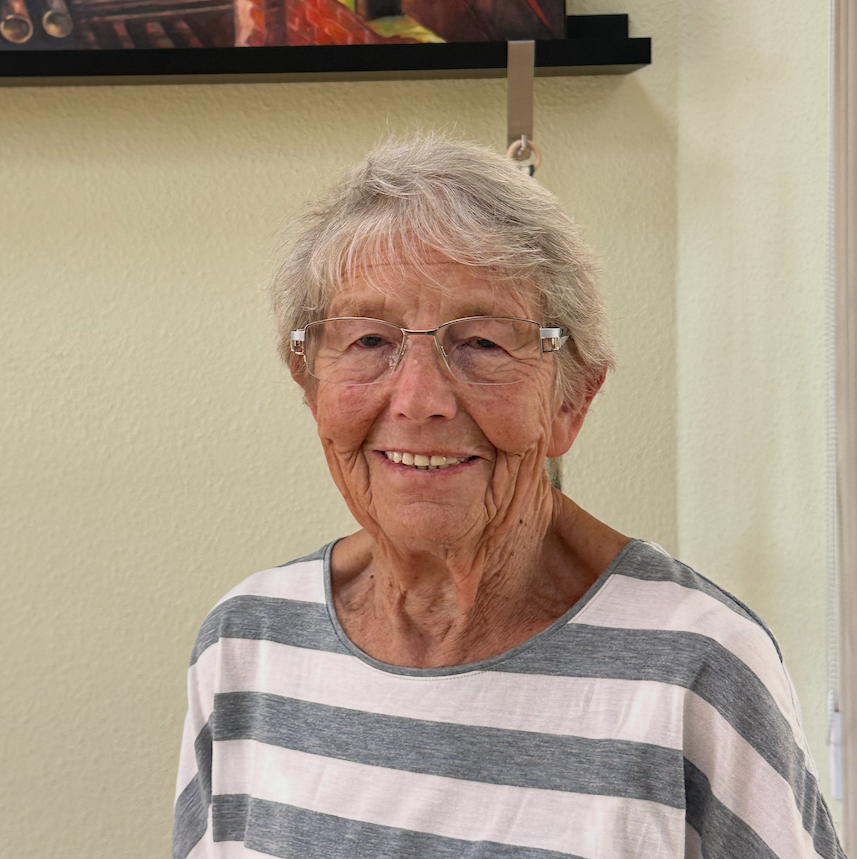
Sigrid Kleiner Photo: Maja Dauser
How old is Saxony-Anhalt?
A person’s age shapes much of their lived reality and personal circumstances. New priorities emerge when senior living facilities and doctors’ offices become an integral part of daily life. Issues such as climate change - whose consequences they are unlikely to witness - may take a back seat for them. Does someone who has already lived most of their life make political decisions differently than someone who still has decades ahead of them?
Saxony-Anhalt is considered the federal state with the highest average age. To understand what this means and how it can be illustrated, we’ll first examine data from the Federal Statistical Office (more under Methodology M2). We will then analyse differences among age groups and across districts in Saxony-Anhalt based on voting behaviour in the 2025 federal election.
Over time, it is evident that the average age in Saxony-Anhalt has risen by six years since 2000, from 42 to 48 years. This corresponds to the average increase in the east (the new federal states). By comparison, during the same period, the average age in Germany rose by only four years, and in the west by just three. The eastern part of Germany, including Saxony-Anhalt, has thus aged about 50% faster than Germany as a whole and even twice as fast as western Germany. If this rate of aging continues, the average age in Saxony-Anhalt would be 54 years in 2048. However, since 2014, the aging curve has flattened significantly due to the immigration-wave.
When considering these statistics, it is important to note that the population in the West is more than five times larger than the one in the East.
It is only after age 60 that there are more women than men, which mainly reflects women’s higher life expectancy. In all younger age groups, the female population is significantly outnumbered. Saxony-Anhalt is thus the oldest federal state in one of the nations with the highest median age on the planet. This is a circumstance (which is not without its challenges for society as a whole) that is clearly evident in the analysed data.
The Demographic Change in Everyday Life
The population of Saxony-Anhalt is shrinking. Sigrid also sees this as a problem; for her, demographic change is not just a matter of numbers. She remembers a time when generations supported one another; after the war, it was the grandparents “who got us through the postwar period,” even though their own pension entitlements “had shrunk dramatically due to the political situation after the war.” Those who earned their own money had to support the older generation: “That was simply the unspoken intergenerational contract that worked.” She believes that wouldn’t be possible today. She also points out that women who want to have children are at a financial disadvantage. Because of the time spent raising children, it’s impossible for them to accumulate as many years of service as a man. This could contribute to a lower birth rate and an aging population. Sigrid would like to see “some recognition for pension credits or even for career advancement” in these circumstances.
Voting patterns by Age
So Saxony-Anhalt clearly has a relatively older population. But does an older population also lead to certain voting patterns? Nicolas Spohn, an election researcher at Otto von Guericke University in Magdeburg, can only partially confirm this:
“Younger people are more volatile in their voting intentions, while older people tend to identify more strongly with a particular party. In the East, however, party loyalty developed only slowly and to a lesser extent after reunification. That is one of the reasons why Saxony-Anhalt has always had a high proportion of swing voters.”
Spohn does not see a causal link between the electoral successes of right-wing populist parties such as the AfD and the high average age in eastern Germany. Such a link cannot be demonstrated in the representative statistics for the 2025 Bundestag election in Saxony-Anhalt either.
One Factor among Many
Saxony-Anhalt has an older average population than any other German state; the data on this is clear. However, a direct link between this older population and the success of right-wing populist parties cannot be confirmed. As election researcher Nicolas Spohn explains, older people do not vote more extremist, but rather for more established parties. Nevertheless, the observation remains: counties with a higher average age are often among those with the highest AfD vote shares (though this is not solely due to the age of the voters). Nevertheless, their interests differ significantly, and the concerns of younger generations may tend to be overlooked in the policies of Saxony-Anhalt’s new state parliament. Sigrid is one of hundreds of thousands of older people who are shaping the election results. However, her age alone does not allow us to predict how she will cast her vote.
by M.S., Noel Agca and Maja Dauser